
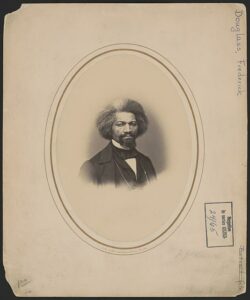
 As the most famous African American freedom fighter, abolitionist and activist of the nineteenth-century, Frederick Douglass was a pioneer in the social justice movement and campaigned for the end of U.S. enslavement, racism, white domestic terrorism and global oppression. He visited Britain three times and befriended key antislavery activists who also happened to be Unitarians and Quakers; several of them worked or wrote for the non-conformist newspaper The Inquirer, including the married couple Mary Carpenter and Russell Lant Carpenter. No scholar has seriously studied the newspaper because copies are extremely hard to come by and only exist in an archive held by a private company.
Between 2023-2024, I worked at Queen Mary, University of London, and I was grateful to receive a small amount of funding to digitize the years 1850-1869 of The Inquirer. After studying its pages, I discovered 17 previously undiscovered letters written by Frederick Douglass. I was confident digitizing the remaining years (1870-1896) would bring similar findings.
I was able to complete this task thanks to a successful application to the Social History Society’s Small Research Grants scheme. The funding was invaluable, and helped me find the following:
- 12 letters from Frederick Douglass, which have never been published before – including the last letter he wrote to the Carpenter family, his long-lasting and steady friends of several decades
- Various newspaper articles reporting on African American lecturing tours, private lives, autobiographies and death
- A long review of Frederick Douglass’ third autobiography, which has never been seen or transcribed and provides crucial details regarding publication and distribution
- Excerpts of Frederick Douglass’ speeches given in the US
- Letters that comment on Ida B. Wells-Barnett’s anti-lynching tour of Britain in 1894 and…
- 1 Letter from Ida B. Wells-Barnett summarizing her lecturing tour of Britain
This research is hugely exciting and provides important insight into Black activist lecturing tours, the anti-racist movement after the US Civil War, transatlantic networks of distribution regarding oratory and literary work, as well as information on private and family life. I’m hoping to publish some of these letters and will incorporate them into my public engagement work, including walking tours, talks and teaching workshops.
To give an example of some of these letters: in one letter dated September 28 1876, Douglass writes to the Carpenter family of the U.S. government’s racism against Indigenous people and their commitment to settler colonialism: “We have heard of gold in the Black Hills – lands long ago reserved to the Indians – and we want to get this gold, and hence we have called upon “Sitting Bull” and his Indian tribes to get out of the way.” When they refused to leave, “soldiers went there to drive them off, to burn their wigwams, and slaughter their wives and children.” As Douglass forewarned, “humanity and justice may be stamped in the dust, but woe to the people under whose heels they are stamped in the dust. A day of reckoning will come.” Speaking of civil rights for African Americans, Douglass was concerned at the political corruption within the Republican Party and powerfully wrote, “the cry of Reform was never more appropriate in [this] point of time.”
The following year (in May 1877), Douglass writes to Carpenter about his recent appointment as Marshal of the District of Columbia. While it was “not an office exactly to my taste” it was a “highly respectable one, and one which is very much coveted by many eminent white citizens of the Republic.” White racists tried to block his appointment, unsurprising given Washington’s position before the Civil War as “the hot-bed of slavery and the slave-trade, and that it was a part of the Marshal’s duty here…to seize and sell coloured people as chattels”, his role was therefore, undoubtedly “full of significance.”
To provide one final example, The Inquirer prints the last ever letter Douglass wrote to Mary Carpenter in early February 1895. Although he felt “pretty well”, he acknowledged that “time and toil have made a decided impression upon me during the last two years” and friends “think me stronger than I am.” Despite the intensity of racism and segregation Black people faced in the United States, he chose to focus on hope: “I find no ground for despondency.” As he had done throughout his life, Douglass fought to expose lynching, white domestic terrorism and the “the persecution and lawless violence” against African Americans. He predicted that “thanks to the moral judgment of the world, no great outrage upon humanity can be long persisted in without demanding rebuke.” As this last letter to British friends demonstrates, Douglass championed civil rights, social justice and an end to global oppression until the very hour he died.
Dr. Hannah-Rose Murray is currently a fixed-term Lecturer in History, at the University of Suffolk. She has published one monograph and 3 anthologies focusing on Black activism in Britain and Ireland in the nineteenth century, and her current monograph, Daguerreotyped Upon My Heart: Black Liberation, Love and Visual Culture in C19th Britain is due out in early 2027. Her accompanying website, www.frederickdouglassinbritain.com attempts to map as many Black activist speaking locations as possible across Britain is the basis for her public engagement work with schools, museums and libraries on both sides of the Atlantic.