
By Anya Kapoor, Giulio Tamburrini and Lena Ferriday
East London in 2026 is a composite of histories and communities, and these layers are often made visible by the urban environment. Bengali families now play in Bethnal Green’s Weavers’ Fields, a park which takes its name from the mid-twentieth-century clearance of cottages that were lived in by the clothing industry’s workforce of French Huguenot and Eastern European Jewish refugees. In factories and workshops across Hackney Wick and Shoreditch, where Londoners once worked in sweltering conditions to make products such as Clarnico’s confectionery and Birnbaum’s rubber clothing, young professionals now work-from-home in overheating property guardianships and airconditioned co-working spaces through the city’s heatwaves. This fracas of cultural heritage is filtered through particular spaces and buildings, which one gentrification project unironically claims brings the ‘industrial charm of 1910 into the 21st century’.[1] Obscuring the disparities of privilege and marginalisation that have characterised historical experiences in these places, this slick marketing of urban development and its ‘regeneration’ of neighbourhoods also hides social dislocations that are profoundly personal and difficult to document.
The project Environmental Change and the Sensory Politics of Belonging in East London, 1830–Present, hosted by King’s College London across 2025, worked to reassemble the pieces of such transitions, as part of a wider project that seeks to examine how urban Britons have historically experienced and negotiated periods of rapid urban transformation. Focusing on nineteenth-century industrialisation and more recent gentrification, it aimed to trace how changing physical environments such as factories, housing, and infrastructure, reshaped the material landscape and people’s senses of home and belonging. While the project was led by Dr Lena Ferriday, as part of a King’s Undergraduate Research Fellowship (KURF) two undergraduate researchers Anya Kapoor (3rd Year, Global Health and Social Medicine) and Giulio Tamburrini (1st Year, History and Political Economy) conducted the researching, setting out to archives across London to identify stories of urban change. In this blog, they reflect on their empirical findings, the process of doing archival work for the first time, and what they have taken away from the experience.
Our search in The London Archives led us to the London County Council’s (LCC) Boundary Street Improvement Scheme, an ambitious housing project to reform one of the city’s most notorious nineteenth-century slums.[2] At the height of the industrial revolution, the precarious nature of work in the East End, combined with the absence of legal rights for tenants, created an environment ripe for poverty and exploitation.[3] Infamously dubbed the ‘Old Nichol’, the slum’s fifteen hectares stretched eastward from Shoreditch High Street and housed an eclectic mix of lodgers, artisans, street vendors, and occasional labourers.[4] An official LCC report that we uncovered warned that the area was ‘a well-known hiding place for criminals of all kinds’.[5] The Nichol’s 5,719 residents lived in damp, dilapidated tenements where severe overcrowding bred cholera, typhus and tuberculosis and drove death rates to more than double the rest of Bethnal Green and London-wide averages.[6] As the century wore on it became increasingly clear that the private market economy was unable to keep up with east London’s outsized housing demands, and as existing housing continued to deteriorate, calls for intervention by parliamentarians, medical officers and social reform journalists grew more insistent.[7]
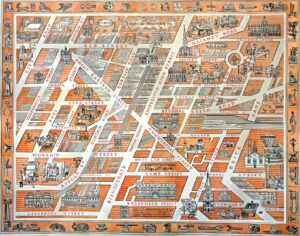
The Boundary Street case study urged us to think beyond the all too familiar observation that housing reform can fail to serve the very people it is meant to help, often displacing them in the process. As we uncovered – in particular public nuisance letters housed at the National Archives – the same question kept resurfacing: why had meaningful action taken so long?[8] Until the formation of the London County Council in , the newly formed LCC finally intervened in 1890 and began relocating the Nichol’s residents before demolishing its tenements in 1894 to make way for the Boundary Estate that occupies the site to this day.[11]
Alongside large-scale clearance schemes, our archival work also drew us to a very different kind of intervention at Toynbee Hall. Founded in 1884 in Whitechapel by Samuel and Henrietta Barnett, the settlement emerged from the same conditions of overcrowding, poverty, and social fragmentation, not far from the Old Nichol. Unlike the Boundary Estate Scheme, which sought to resolve these conditions through demolition and reconstruction, Toynbee Hall attempted to intervene at the level of social relations.[12] Its model was based on proximity: university-educated men, largely from Oxford and Cambridge, took up residence in the East End, offering evening classes, lectures, and legal advice while living among working-class communities.[13] The aim was not simply to provide services, but to cultivate a shared sense of community across class lines.
During our work on the project, we were concerned with how ideas of working-class belonging were constructed and how these shaped interventions, whilst also how specific socioeconomic conditions that gave rise to projects such as Toynbee Hall and the Boundary Estate. One such major finding was that belonging in late-nineteenth-century East London was not always a self-defined experience, but one that was also imposed upon working people. Despite their different approaches, both projects emerged from a shared belief that improving working-class life required the reordering of social and urban space in a certain way. Toynbee Hall represented a voluntarist, philanthropic model structured by a paternalistic logic in which upper-class residents positioned themselves as moral guides on what constituted a “proper” way of living. The Boundary Estate, by contrast, embodied a state-driven vision, using demolition and reconstruction to impose ideals of cleanliness, order, and respectability onto the urban environment, often at the cost of displacing existing communities. Because the sources were largely produced by reformers, officials, and institutions, rather than the residents they targeted, these case studies reconfirmed our initial assumption, that the lived experiences of regeneration are often eclipsed in the archive and related historiography.
As we read these institutional archives, it became clear that the sources did not neatly allow us to reconstruct the experiences of those we had tried to recover and led us to learn a lot about the process of archival research. Much of the historical education we had previously encountered had focussed on understanding the nature of historical argumentation, and so we first approached the archive with a view to identifying controversies and debates. While this drew us to moments where urban change was explicitly discussed – such as in parliamentary debate and local council meetings – in these documents the experience of transition was only made visible through the ideas of those in power. A more productive lens might have been to focus on what stuck out as surprising in the archive and challenged or contested well-trodden analyses of urban change. First-hand encounter with the archives therefore really cemented the importance of positionality and being-in-place to the writing of history and the production of historical meaning. Going forwards we will be acutely attentive to asking where certain arguments, information and ideas are derived from, both in historiography and across other fields. It is not only History students who seek to gain from the archive: undergraduate students are often unaware that a lot of the information taken for granted in other subjects was once found in archival material and is subject to change and debate. Bringing STEM students into the archive would perhaps facilitate a different line of thinking about their subjects as more than just an objective way of knowing the world.
It was our physical proximity to the archive and primary materials that solidified these learnings for us. The embodied experience of touching the materials that were inked by the historical actors we studied allowed us to think about connections across time, and the expertise of the archivists was highlighted as we struggled to identify relevant sources. We also came to understand the types of material that are archived, and how archives themselves might be prejudiced towards particular materials and putting forwards a particular narrative. For instance, whilst we found the National Archives valuable for material on legislative and inspection-based public health interventions, and the London Archives for institutional records and local planning minutes which detail discussions and objections to planned works, the Tower Hamlets archive offered us life narratives and personal records which gave us an insight into the lived experiences of those facing domestic dislocation.[14] Issues of the Bethnal Green News from 1894-5 hosted an ‘East London Echoes’ column which shared the thoughts of anonymous local residents that the newspaper’s journalist had informally picked up and compiled.[15]

As a first foray into the archives, grappling with unfamiliar document-ordering processes, handling original primary material for the first time, and trying to draw out themes that connected the evidence to the project’s broader research questions, with a limited understanding of the relevant secondary literature, was a demanding task. This meant that additionally trying to read these materials against the grain to find sensory experiences – as the PI had originally conceived of doing – was perhaps one step too far. Instead of original contributions to scholarship, the takeaway from this project was our newfound confidence in navigating spaces of historical research. Moving away from the emphasis on intellectual debate that we have both encountered in our taught degrees at KCL, and towards thinking about where historians and social scientists have drawn their evidence from, has offered us a new lens into understanding these scholarly conversations. It is something to be encouraged, in pedagogy and continued opportunities for students to take ownership over academic research at an early stage in their undergraduate training.
[1] https://hackneywickwarehouse.com/ [accessed 6 Oct 2026].
[2] Anthony Wohl, The Eternal Slum: Housing and Social Policy in Victorian London (Routledge, 2017) p. 28.
[3] James Greenwood, ‘London Courts and Alleys’, Standard (London, 1875); Sarah Wise, The Blackest Streets: The Life and Death of a Victorian Slum (London, 2009), pp. 30-36.
[4] Charles Booth, Maps Descriptive of London Poverty (1894-1899), LSE Archives, BOOTH/E/2.
[5] C. J. Stewart, The Housing Question in London, 1855-1900, p. 192.
[6] C.J. Stewart, The Housing Question in London, 1855-1900, pp. 191-2.
[7] ‘The Metropolitan Board and the Artisans’ Dwellings Act’, The East London Observer, (21 August 1880).
[8] Correspondence: Metropolitan Nuisances (1848-70), The National Archives (TNA), MH13/261-5.
[9] Wise, The Blackest Streets, pp. 16-17.
[10] ‘Dwellings Act Difficulties’, The East London Observer, (13 December 1879).
[11] Presented Papers: Boundary Street Scheme, Bethnal Green (Mar-Dec 1896), TLA, LCC/MIN/07353.
[12] Report on Toynbee Hall (1915), TLA, A/TOY/006/013.
[13] Toynbee Hall: Material relating to daytime visits by students as part of Oxford and Cambridge Study Week, TLA, A/TOY/015.
[14] For example: Sanitary Inspectors’ Examination Board: correspondence and papers, (1891-1907), TNA, MH 26/1-5; Metropolitan Board of Works: Dwelling House Improvement Fund (1875-92), TLA, MBW/1986; Metropolitan Board of Works: Local Improvement Plans, Bethnal Green (1862-1888), TLA, MBW/2459.
[15] The Bethnal Green News (1894-1895), Tower Hamlets Archive, LC730.