
By Rebecca Ball, Manchester Metropolitan University
This summer, on 21 and 22 July 2026, my co-conference convenor, Professor Rob Ellis, and I had the pleasure of welcoming academics, practitioners, experts, and advocates to the Life Histories in Mind: Mental Ill Health and Learning Disability in Context conference, held at Manchester Metropolitan University.
From the outset, it was clear that this would be a friendly, engaging, and intellectually stimulating event. Delegates travelled from across the UK and overseas, bringing together a diverse commu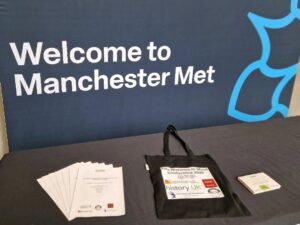 nity of scholars and professionals. Throughout the conference, participants were collegiate, respectful, and all shared an understanding of the importance of researching biographies and life histories of mental ill health and learning disabilities.
Across the two days, attendees participated in a variety of thought-provoking panels covering a wide range of topics. These included representations of madness in heritage, art, and literature; revolutionary life stories, activism, and dissent; institutional power and lived experiences. The breadth of perspectives highlighted the ongoing excellent research in this field and new areas of inquiry.
We were also fortunate to welcome two outstanding keynote speakers: Professor Catharine Coleborne (University of Newcastle, Australia and Visiting Professor at MMU) and Dr Jane Stockdale (Mental Health Museum, Wakefield and Visiting Research Fellow at MMU). Both speakers shared insights from their recent projects and showcased invaluable research that aims to foreground the voices of everyday lived experiences.
The conference concluded with a networking session, providing attendees with an opportunity to connect, exchange ideas, and discuss future collaborations. We were delighted that several delegates asked whether the conference might be held again in future years. If it is, we will certainly ensure that the hot lunch option remains on the menu, as it proved extremely popular with attendees.
Rob and I would also like to extend our sincere thanks to all those who supported the conference, including the Social History Society. Their contribution helped make the event a great success, and we are grateful for their support.
Testimonies from Participants:
 Matthew B (ECR)
Attending the ‘Life Histories in Mind: Mental Health and Learning Disability in Context’ was a wholly positive experience for me as an Early Career Researcher. Attendance allowed me to present my research to a multidisciplinary audience consisting of leading scholars in the field, allowing me to engage in individual and group discussions with numerous experts, which prompted me to think about my own research practice, particularly with regard to ethical considerations and possible lines of future research enquiry. This networking aspect of attending the conference, both in professional and social contexts, was one of the highlights of my experience because it has led to continued discussion and knowledge exchange with leading scholars after the conference, allowing me to draw on their expertise and think about how I can approach future research projects. Another highlight of the conference was the fact that speakers were drawn from a wide range of disciplines and contexts, including historians, museum curators, and medical and support practitioners. Moreover, papers focused on both the British and international contexts. Thus, the range of papers delivered at the conference was broad and multifaceted, allowing me to learn about a wide range of topics which piqued my intellectual curiosity and have given me inspiration for future research. As an Early Career Researcher who does not work in an academic position, I would not have been able to attend the conference without being awarded a bursary. Thus, the award of a bursary allowed me to develop my professional and research practice by attending the conference, stimulating intellectual discussion and networking opportunities.
Amy H (PhD Student)
This July, the ‘Life Histories in Mind: Mental Ill Health and Learning Disability in Context’ conference was held at Manchester Metropolitan University (MMU), organised by Rebecca Ball, Rob Ellis, and Leonie Chesworth. Thanks to the support of the Social History Society, I was able to join both days of the event and present my PhD research.
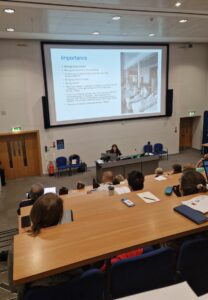
The conference was intentionally a smaller group, with each of the thirty-six attendees also being a speaker. Attendees ranged from PhD students to professors and academics to healthcare workers – joining from across the UK and as far as Canada, Denmark, and Australia. With the small group setting juxtaposed against the tall glass windows of the MMU’s Dalton Building, the overall atmosphere was intellectual and expansive.
There were two fabulous keynote lectures by Prof. Catharine Coleborne and Dr Jane Stockdale. The first discussed work from the ‘Life Outside Institutions’ project at the University of Newcastle, highlighting the stories of people accessing mental health aftercare in Australia and the organisations who supported them. The second considered the ‘Asylum: Refugees and Mental Health’ project and the Mental Health Museum in Wakefield, illustrating the museum’s role in capturing a nuanced history of mental health in Britain, as well as being a space for individuals today to reflect on their own life histories. These talks defined the overall aims of the conference: aiming to re-centre individual lives and stories in histories of mental illness and learning disability, grounded in a wider discussion of heritage, historiography, and political activism. Research from the panel sessions varied from archival case histories, practices in co-production and personal experience, and mental health communities in the arts, to name a few.
My presentation was during one of the first panels (‘Narrating Minds: Lived Experience, Institutions, and Deinstitutionalisation’). Drawing on the first chapter of my PhD research, it considered the first scholarly collections of mental illness narratives in the UK, published by medical doctors and psychiatrists in the mid-twentieth century.1-3 The first of these collections was published in 1957 by Donald Johnson (a doctor and an MP who would go on to instate the role of the parliamentary Ombudsman) and Norman Dodds (an MP who defeated Margaret Thatcher when she first stood for parliament). The value of the narratives was reiterated across the collections at the time, describing them as ‘raw material’ or ‘data’ to explore the ‘insider’ or ‘subjective experience’ of patients.4 Moreover, for the first time, patients with mental illness were described by scholars as ‘patient-persons’ and ‘experts’.5 Similar to the role of the Ombudsman – who acts as an independent official handling complaints about unjust treatment – these collections offered a platform for the patient voice for the first time, albeit through the indirect means of first-person narrative.
During the presentation, I outlined later thesis chapters, including the disciplinary shifts in scholarly collections across the period (published by psychologists, social historians, and interdisciplinary medical humanities) and their increased publication alongside political and sociocultural activist movements. This historiography informs the ongoing challenges of co-production and knowledge exchange, and speaks to a key question of my research: how does a first-person experience become collective?
The conference was very insightful, and I feel grateful to have been a part of it. I left feeling inspired and with so much great research to reflect on. As a part-time PhD student, it was invaluable to be around like-minded individuals who were enthusiastic and engaged across the full two days. I can only extend my thanks again to the Social History Society, to the organisers, and to all the attendees for such a great event.
- Johnson D, Dodds N (eds.). The Plea for the Silent (1957).
- Sommer R, Osmond H. ‘Autobiographies of former mental patients’ Journ Ment Sci. 106 (1960) pp. 648-62.
- Landis C, Mettler F (eds.). Varieties of Psychopathological Experience (1964).
- ‘data’ and ‘insider’: Sommer R, Osmond, Ibid, p. 651 and p. 649; ‘raw material’ and ‘subjective experience’: Landis C, Mettler F, Ibid, p. xiii and p.xiv.
- ‘patient-persons’: Johnson D, Dodds N, Ibid, p. 8; ‘experts’: Sommer R, Osmond H, Ibid, p. 648.
Jan C (PhD student)
It was a huge honour to be invited to share my doctoral research work-in-progress at the Life Histories in Mind conference in July and a rare opportunity to hear about the diversity of work being undertaken in the fields of history and mental health by scholars, educators, curators, archivists and activists at such different stages of their careers. It is always good to make new connections, and for me this meant having my research inquiries affirmed, enriched and challenged: a chance to reconsider my approaches from unexpected perspectives raised by audience members. But perhaps more significantly than this, to experience the support of academics much more expert than me, who were prepared to help me frame and articulate my research arguments more precisely.
My study investigates storytelling through cloth. Its aim is to understand how women patients in 19th century asylums used independent textile-making, unmaking (tearing) and repairing (remaking) to make sense of their lives and to support their mental wellbeing. With few firsthand accounts, my challenge is to authentically interpret the historic women’s intentions and the institutions’ purpose in facilitating such practice.
I use focused archival methods to examine and analyse the textiles alongside biographical information (patient case notes) and, having drawn out the themes of patients’ meaning-making, experience the processes of reflexive textile-making for myself, creating provocative artworks with the aim of generating new conversations around creativity and wellbeing today.
I would like to extend special thanks to Professors Rob Ellis and Catharine Coleborn for the generous insights they provided throughout the conference and to Dr Cecilia Rodéhn who linked me in to a network of specialists to help me in the next stage of my research, to further interpret the textile archive at Lund, Sweden.
Alessandro B (PhD student)
On 21–22 July 2026, I had a wonderful time attending the ‘Life Histories in Mind: Mental Ill Health and Learning Disabilities in Context’ conference held at Manchester Metropolitan University and organised by Dr Rebecca Ball, Professor Rob Ellis and Leonie Chesworth.
I presented on the first day of the event on panel B1, ‘Embodied Suffering, Institutional Power: Authority, Narrative, and Lived Experience in Nineteenth Century.’ My paper, ‘Hell is Empty: Sorrow and Demonic Perceptions of Mental Treatment in Early Nineteenth-Century France,’ analysed three accounts by nineteenth-century patients. I argued that within their writings, French patients often appropriated and inverted alienist discourse. Whilst doctors depicted the asylum as a paradise, demonic possession as madness, and mental illness as suffering, many convalescents perceived treatment as a mainspring of sorrow, alienists as demons who caused mental illness, and psychiatric institutions as replicas of hell.
As a PGR, I expected the conference to be quite daunting; however, when I first stepped into the Dalton Building, I found the event—from the warm welcome of the organisers to the relaxed atmosphere when first introducing myself to other speakers over a coffee—to be very friendly. This climate permeated the whole of the conference: questions were engaging, challenging at times, but always framed with mindfulness and curiosity. Researchers shared their views on ethical conundrums surrounding access to sources, providing the real names of patients, and sharing sensitive information contained in clinical records. Moreover, they stressed the importance of engaging with one’s own positionality vis-à-vis sources past and present. Through a large range of geographical and temporal scales, spanning five continents and four centuries, speakers were encouraged to make links across periods and national boundaries, thus stimulating a collaborative environment. Indeed, there was a genuine desire to learn from one another, which was in many ways a direct consequence of Dr Ball’s introductory speech.
Coffee and lunch breaks were a wonderful chance to meet new researchers, discuss papers and projects, and explore Dr Helen Atherton’s exhibition, ‘Finding Ivy’, which sought to tell the story of the victims of the Aktion T4 mass-killing programme in Nazi Germany who had been born in England. The evening social event at the Rain Bar created a cosy environment within which I found I could discuss research as much as connect with other speakers by talking about non-academic subjects—from movies to Italian food and cultural differences.
The keynotes provided a perfect duality. Prof. Catharine Coleborne opened up discussions concerning the legal, administrative and academic challenges and opportunities of working with unexplored archives. One particularly striking question she asked has remained with me: ‘How do we people the past of mental ill health outside the institution?’ It perfectly encapsulated the tension of representing life under institutionalisation without reducing patients’ experiences to the asylum. On the other hand, Dr Jane Stockdale stimulated me to think of the challenges of representing mental ill health and learning disability in the present. Such representations of past experiences, Dr Stockdale stressed, need to be negotiated with the sensibilities and responses of those who continue to experience these conditions today. These themes seemed to reappear in and colour all panels.
Other interesting considerations emerged. Drs Rebecca Wynter and Len Smith emphasised that the experiences of women patients should not be seen as representative of the experiences of all women. Whilst some were institutionalised, others owned private asylums. Finally, Amberlea Jones and Prof. Sonu Shamdasani emphasised a crucial point: giving voice to the experiences of patients should not come at the cost of erasing the intentions and endeavours of doctors. Whilst convalescents may have suffered in institutional contexts, physicians often did attempt to engage with their idiosyncratic circumstances and try to help them.
When the final drinks reception began, I was sorry to have to leave after a mere thirty minutes. I wanted to stay and talk more, discuss presentations, and ask all those questions which I had not managed to pose during sessions. On the return train with Amberlea Jones, as we made our way back to Newcastle, we both agreed: the event had been truly wonderful, and neither one of us could truly think of a time when we had been more inspired to delve back into our research—refreshed and electrified.