
Revolutionary Connections: Russia and Ireland, 1905-1923 by Anna Lively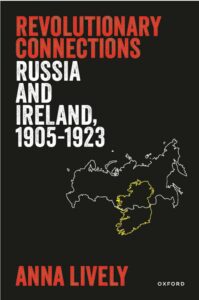
International news mattered in revolutionary Russia and Ireland. These were highly news-conscious revolutionaries, deeply aware of the power of the media, the potential for attracting international support and how domestic news was being re-told abroad. Revolutionary Connections: Russia and Ireland, 1905-1923, out now open access with Oxford University Press, examines relations between Russia and Ireland from the 1905 Russian Revolution to the end of the Irish Civil War in 1923. It considers how, when and why international news stories matter in domestic politics. Drawing on a wide range of Russian and Irish archival, press and published sources, it explores Russo-Irish connections from different religious perspectives and from across the political spectrum.
By 1923, both Ireland and Russia had undergone major political transformations in a period which saw the creation of the Irish Free State, Northern Ireland and the Soviet Union. Despite the obvious differences between Russia and Ireland’s political trajectories, many contemporary commentators made comparisons between the two contexts, including in terms of land struggles, self-determination and revolutionary methods.
International comparisons could serve as lessons and warnings, tools for legitimacy-building, vehicles for debating contentious topics or mirrors onto domestic affairs. They could form part of ambitious plans to foster international collaboration, and as sources of literary inspiration. They could also be deeply personal, shaped by migration, travel and personal relationships.
Each chapter of the book foregrounds key areas of debate in the Russian and Irish revolutionary periods, including imperialism and resistance; socialism and religious faith; allied relationships during World War One; nationalism; and communism and international revolution. They also consider perspectives from the Irish diaspora and Russian émigré communities, as well as from different areas of the Russian Empire.
Russo-Irish and Irish-Soviet histories have, understandably, focused mostly on the radical side of Irish politics. Revolutionary Connections argues that there is also value in taking a much wider lens. As is increasingly recognised, socially-conservative and right-wing as well as left-wing movements are often highly internationalised, tapping into transnational networks of propaganda, funds and personnel. During the Irish War of Independence, opponents of Irish republicanism in Britain, the US and Ireland itself sought to weaponise claims of ‘Bolshevik-Sinn Féin’ to associate Irish republicanism with anarchy and disorder. As explored in the second chapter, international influences helped to shape Irish anti-communism in the wake of the Bolshevik takeover of power, driving claims of a global communist conspiracy and threat to the family and social order.
Revolutionary Connections also reveals a much greater and more diverse engagement with Ireland in Russian-language texts than is generally acknowledged. It suggests the power of imaginings of Ireland beyond the Anglophone world and the meanings that became associated with the Irish struggle abroad, including among those who never travelled to Ireland. Chapter one sheds light on little-known Russian writers on Ireland, including the journalist, writer and translator, Emiliia Pimenova. While Pimenova was initially sympathetic to Irish constitutional nationalism and Home Rule, she developed a much more radical view of Ireland in response to the 1916 Easter Rising. The final chapter also considers how Soviet attitudes to Ireland evolved after 1917, reflecting on the construction of radical solidarities and the challenges and opportunities involved.
The book situates connections between Russia and Ireland in the context of wider anxieties over technology and misinformation. This was a period when news stories were available at much faster speeds and in much larger quantities, particularly through international news agencies and vast telegraph networks. While this infrastructure was uneven, it meant that a single news story from Ireland could reach the regional press in Vladivostok in the far east of Russia. This connectivity raised questions about control and agency. For some Irish republicans, the British news agency Reuters was a source of ‘fake news’ (to use the modern term), which could not be trusted on domestic or international affairs.
Equally, temporary breakdowns and delays in communication led to intense anxieties. As explored in chapter three, this was felt particularly acutely by the over 100 Irish-born men serving on the Eastern front during World War One. Stranded by thick ice in the far north of Russia, they were unable to gain up-to-date news on the Easter Rising. Language barriers and misunderstandings also feature heavily in both Russian and Irish eyewitness accounts of the allied intervention in the Russian civil wars.
Exploring far-reaching entanglements and experiences, this book tells a story about (mis)communications, selectivity and what gets lost in translation, as well as about the perennial desire to find connections and parallels in sometimes unlikely places.
Dr Anna Lively is a Leverhulme Early Career Fellow at the University of Strathclyde. Revolutionary Connections: Russia and Ireland, 1905-1923 is published by Oxford University Press and available Open Access.